Irony: Andrew Jackson On a Federal Reserve Note
by John Rubino on January 9, 2010
Karl Golovin, a retired customs agent and security director for Ron Paul’s presidential campaign, just forwarded a transcript of Andrew Jackson’s farewell address. It’s pretty amazing. Here’s Karl’s intro, followed by an excerpt:
“During his presidency, Andrew Jackson viewed as his crowning achievement that he “Killed the Bank,” the 2nd Bank of the U.S. Our current ‘Federal Reserve,’ created in 1913, is the 3rd Bank of the U.S. Jackson was intent upon restoring an honest, Constitutional monetary system. There probably never has been written a more articulate, prophetic vision of what calamity would befall our nation if we did not diligently stay that course, as argued by Jackson in the following excerpt from his farewell address in 1837. It reads as if written this very day about our present financial circumstances:”
“. . . . In reviewing the conflicts which have taken place between different interests in the United States and the policy pursued since the adoption of our present form of Government, we find nothing that has produced such deep-seated evil as the course of legislation in relation to the currency. The Constitution of the United States unquestionably intended to secure to the people a circulating medium of gold and silver. But the establishment of a national bank by Congress, with the privilege of issuing paper money receivable in the payment of the public dues, and the unfortunate course of legislation in the several States upon the same subject, drove from general circulation the constitutional currency and substituted one of paper in its place.
It was not easy for men engaged in the ordinary pursuits of business, whose attention had not been particularly drawn to the subject, to foresee all the consequences of a currency exclusively of paper, and we ought not on that account to be surprised at the facility with which laws were obtained to carry into effect the paper system. Honest and even enlightened men are sometimes misled by the specious and plausible statements of the designing. But experience has now proved the mischiefs and dangers of a paper currency, and it rests with you to determine whether the proper remedy shall be applied.
The paper system being founded on public confidence and having of itself no intrinsic value, it is liable to great and sudden fluctuations, thereby rendering property insecure and the wages of labor unsteady and uncertain. The corporations which create the paper money cannot be relied upon to keep the circulating medium uniform in amount. In times of prosperity, when confidence is high, they are tempted by the prospect of gain or by the influence of those who hope to profit by it to extend their issues of paper beyond the bounds of discretion and the reasonable demands of business; and when these issues have been pushed on from day to day, until public confidence is at length shaken, then a reaction takes place, and they immediately withdraw the credits they have given, suddenly curtail their issues, and produce an unexpected and ruinous contraction of the circulating medium, which is felt by the whole community. The banks by this means save themselves, and the mischievous consequences of their imprudence or cupidity are visited upon the public. Nor does the evil stop here. These ebbs and flows in the currency and these indiscreet extensions of credit naturally engender a spirit of speculation injurious to the habits and character of the people. We have already seen its effects in the wild spirit of speculation in the public lands and various kinds of stock which within the last year or two seized upon such a multitude of our citizens and threatened to pervade all classes of society and to withdraw their attention from the sober pursuits of honest industry. It is not by encouraging this spirit that we shall best preserve public virtue and promote the true interests of our country; but if your currency continues as exclusively paper as it now is, it will foster this eager desire to amass wealth without labor; it will multiply the number of dependents on bank accommodations and bank favors; the temptation to obtain money at any sacrifice will become stronger and stronger, and inevitably lead to corruption, which will find its way into your public councils and destroy at no distant day the purity of your Government. Some of the evils which arise from this system of paper press with peculiar hardship upon the class of society least able to bear it. A portion of this currency frequently becomes depreciated or worthless, and all of it is easily counterfeited in such a manner as to require peculiar skill and much experience to distinguish the counterfeit from the genuine note. These frauds are most generally perpetrated in the smaller notes, which are used in the daily transactions of ordinary business, and the losses occasioned by them are commonly thrown upon the laboring classes of society, whose situation and pursuits put it out of their power to guard themselves from these impositions, and whose daily wages are necessary for their subsistence. It is the duty of every government so to regulate its currency as to protect this numerous class, as far as practicable, from the impositions of avarice and fraud. It is more especially the duty of the United States, where the Government is emphatically the Government of the people, and where this respectable portion of our citizens are so proudly distinguished from the laboring classes of all other nations by their independent spirit, their love of liberty, their intelligence, and their high tone of moral character. Their industry in peace is the source of our wealth and their bravery in war has covered us with glory; and the Government of the United States will but ill discharge its duties if it leaves them a prey to such dishonest impositions. Yet it is evident that their interests can not be effectually protected unless silver and gold are restored to circulation.
These views alone of the paper currency are sufficient to call for immediate reform; but there is another consideration which should still more strongly press it upon your attention.
Recent events have proved that the paper-money system of this country may be used as an engine to undermine your free institutions, and that those who desire to engross all power in the hands of the few and to govern by corruption or force are aware of its power and prepared to employ it. Your banks now furnish your only circulating medium, and money is plenty or scarce according to the quantity of notes issued by them. While they have capitals not greatly disproportioned to each other, they are competitors in business, and no one of them can exercise dominion over the rest; and although in the present state of the currency these banks may and do operate injuriously upon the habits of business, the pecuniary concerns, and the moral tone of society, yet, from their number and dispersed situation, they can not combine for the purposes of political influence, and whatever may be the dispositions of some of them their power of mischief must necessarily be confined to a narrow space and felt only in their immediate neighborhoods.
But when the charter for the Bank of the United States was obtained from Congress it perfected the schemes of the paper system and gave to its advocates the position they have struggled to obtain from the commencement of the Federal Government to the present hour. The immense capital and peculiar privileges bestowed upon it enabled it to exercise despotic sway over the other banks in every part of the country. From its superior strength it could seriously injure, if not destroy, the business of any one of them which might incur its resentment; and it openly claimed for itself the power of regulating the currency throughout the United States. In other words, it asserted (and it undoubtedly possessed) the power to make money plenty or scarce at its pleasure, at any time and in any quarter of the Union, by controlling the issues of other banks and permitting an expansion or compelling a general contraction of the circulating medium, according to its own will. The other banking institutions were sensible of its strength, and they soon generally became its obedient instruments, ready at all times to execute its mandates; and with the banks necessarily went also that numerous class of persons in our commercial cities who depend altogether on bank credits for their solvency and means of business, and who are therefore obliged, for their own safety, to propitiate the favor of the money power by distinguished zeal and devotion in its service. The result of the ill-advised legislation which established this great monopoly was to concentrate the whole moneyed power of the Union, with its boundless means of corruption and its numerous dependents, under the direction and command of one acknowledged head, thus organizing this particular interest as one body and securing to it unity and concert of action throughout the United States, and enabling it to bring forward upon any occasion its entire and undivided strength to support or defeat any measure of the Government. In the hands of this formidable power, thus perfectly organized, was also placed unlimited dominion over the amount of the circulating medium, giving it the power to regulate the value of property and the fruits of labor in every quarter of the Union, and to bestow prosperity or bring ruin upon any city or section of the country as might best comport with its own interest or policy.
We are not left to conjecture how the moneyed power, thus organized and with such a weapon in its hands, would be likely to use it. The distress and alarm which pervaded and agitated the whole country when the Bank of the United States waged war upon the people in order to compel them to submit to its demands can not yet be forgotten. The ruthless and unsparing temper with which whole cities and communities were oppressed, individuals impoverished and ruined, and a scene of cheerful prosperity suddenly changed into one of gloom and despondency ought to be indelibly impressed on the memory of the people of the United States. If such was its power in a time of peace, what would it not have been in a season of war, with an enemy at your doors? No nation but the freemen of the United States could have come out victorious from such a contest; yet, if you had not conquered, the Government would have passed from the hands of the many to the hands of the few, and this organized money power from its secret conclave would have dictated the choice of your highest officers and compelled you to make peace or war, as best suited their own wishes. The forms of your Government might for a time have remained, but its living spirit would have departed from it.
The distress and sufferings inflicted on the people by the bank are some of the fruits of that system of policy which is continually striving to enlarge the authority of the Federal Government beyond the limits fixed by the Constitution. The powers enumerated in that instrument do not confer on Congress the right to establish such a corporation as the Bank of the United States, and the evil consequences which followed may warn us of the danger of departing from the true rule of construction and of permitting temporary circumstances or the hope of better promoting the public welfare to influence in any degree our decisions upon the extent of the authority of the General Government. Let us abide by the Constitution as it is written, or amend it in the constitutional mode if it is found to be defective.
The severe lessons of experience will, I doubt not, be sufficient to prevent Congress from again chartering such a monopoly, even if the Constitution did not present an insuperable objection to it. But you must remember, my fellow-citizens, that eternal vigilance by the people is the price of liberty, and that you must pay the price if you wish to secure the blessing. It behooves you, therefore, to be watchful in your States as well as in the Federal Government. The power which the moneyed interest can exercise, when concentrated under a single head and with our present system of currency, was sufficiently demonstrated in the struggle made by the Bank of the United States. Defeated in the General Government, tho same class of intriguers and politicians will now resort to the States and endeavor to obtain there the same organization which they failed to perpetuate in the Union; and with specious and deceitful plans of public advantages and State interests and State pride they will endeavor to establish in the different States one moneyed institution with overgrown capital and exclusive privileges sufficient to enable it to control the operations of the other banks. Such an institution will be pregnant with the same evils produced by the Bank of the United States, although its sphere of action is more confined, and in the State in which it is chartered the money power will be able to embody its whole strength and to move together with undivided force to accomplish any object it may wish to attain. You have already had abundant evidence of its power to inflict injury upon the agricultural, mechanical, and laboring classes of society, and over those whose engagements in trade or speculation render them dependent on bank facilities the dominion of the State monopoly will be absolute and their obedience unlimited. With such a bank and a paper currency the money power would in a few years govern the State and control its measures, and if a sufficient number of States can be induced to create such establishments the time will soon come when it will again take the field against the United States and succeed in perfecting and perpetuating its organization by a charter from Congress.
It is one of the serious evils of our present system of banking that it enables one class of society–and that by no means a numerous one–by its control over the currency, to act injuriously upon the interests of all the others and to exercise more than its just proportion of influence in political affairs. The agricultural, the mechanical, and the laboring classes have little or no share in the direction of the great moneyed corporations, and from their habits and the nature of their pursuits they are incapable of forming extensive combinations to act together with united force. Such concert of action may sometimes be produced in a single city or in a small district of country by means of personal communications with each other, but they have no regular or active correspondence with those who are engaged in similar pursuits in distant places; they have but little patronage to give to the press, and exercise but a small share of influence over it; they have no crowd of dependents about them who hope to grow rich without labor by their countenance and favor, and who are therefore always ready to execute their wishes. The planter, the farmer, the mechanic, and the laborer all know that their success depends upon their own industry and economy, and that they must not expect to become suddenly rich by the fruits of their toil. Yet these classes of society form the great body of the people of the United States; they are the bone and sinew of the country–men who love liberty and desire nothing but equal rights and equal laws, and who, moreover, hold the great mass of our national wealth, although it is distributed in moderate amounts among the millions of freemen who possess it. But with overwhelming numbers and wealth on their side they are in constant danger of losing their fair influence in the Government, and with difficulty maintain their just rights against the incessant efforts daily made to encroach upon them. The mischief springs from the power which the moneyed interest derives from a paper currency which they are able to control, from the multitude of corporations with exclusive privileges which they have succeeded in obtaining in the different States, and which are employed altogether for their benefit; and unless you become more watchful in your States and check this spirit of monopoly and thirst for exclusive privileges you will in the end find that the most important powers of Government have been given or bartered away, and the control over your dearest interests has passed into the hands of these corporations.
The paper-money system and its natural associations–monopoly and exclusive privileges–have already struck their roots too deep in the soil, and it will require all your efforts to check its further growth and to eradicate the evil. The men who profit by the abuses and desire to perpetuate them will continue to besiege the halls of legislation in the General Government as well as in the States, and will seek by every artifice to mislead and deceive the public servants. It is to yourselves that you must look for safety and the means of guarding and perpetuating your free institutions. In your hands is rightfully placed the sovereignty of the country, and to you everyone placed in authority is ultimately responsible. It is always in your power to see that the wishes of the people are carried into faithful execution, and their will, when once made known, must sooner or later be obeyed; and while the people remain, as I trust they ever will, uncorrupted and incorruptible, and continue watchful and jealous of their rights, the Government is safe, and the cause of freedom will continue to triumph over all its enemies.
But it will require steady and persevering exertions on your part to rid yourselves of the iniquities and mischiefs of the paper system and to check the spirit of monopoly and other abuses which have sprung up with it, and of which it is the main support. So many interests are united to resist all reform on this subject that you must not hope the conflict will be a short one nor success easy. My humble efforts have not been spared during my administration of the Government to restore the constitutional currency of gold and silver, and something, I trust, has been done toward the accomplishment of this most desirable object; but enough yet remains to require all your energy and perseverance. The power, however, is in your hands, and the remedy must and will be applied if you determine upon it….”
Showing posts with label Congress. Show all posts
Showing posts with label Congress. Show all posts
Monday, April 11, 2011


Saturday, April 10, 2010
How to "Fix" the Government
This makes sense to me. Now if only "we the people" had enough power to make it happen.
THIS IS HOW YOU FIX CONGRESS!!!!!A friend sent this along to me. I can't think of a reason to disagree. I am sending this to virtually everybody on my e-mail list and that includes conservatives, liberals, and everybody in between. Even though we disagree on a number of issues, I count all of you as friends. My friend and neighbor wants to promote a "Congressional Reform Act of 2010". It would contain eight provisions, all of which would probably be strongly endorsed by those who drafted the Constitution and the Bill of Rights.
I know many of you will say, "this is impossible". Let me remind you, Congress has the lowest approval of any entity in Government, now is the time when Americans will join together to reform Congress - the entity that represents us.
We need to get a Senator to introduce this bill in the US Senate and a Representative to introduce a similar bill in the US House. These people will become American hero's..
Thanks,
A Fellow American
***********************************
Congressional Reform Act of 2010
1. Term Limits: 12 years only, one of the possible options below.
A. Two Six year Senate terms
B. Six Two year House terms
C. One Six year Senate term and three Two Year House terms
Serving in Congress is an honor, not a career. The Founding Fathers envisioned citizen legislators, serve your term(s), then go home and back to work.
2. No Tenure / No Pension:
A congressman collects a salary while in office and receives no pay when they are out of office.
Serving in Congress is an honor, not a career. The Founding Fathers envisioned citizen legislators, serve your term(s), then go home and back to work.
3. Congress (past, present & future) participates in Social Security:
All funds in the Congressional retirement fund moves to the Social Security system immediately. All future funds flow into the Social Security system, Congress participates with the American people.
Serving in Congress is an honor, not a career. The Founding Fathers envisioned citizen legislators, server your term(s), then go home and back to work.
4. Congress can purchase their own retirement plan just as all Americans.
Serving in Congress is an honor, not a career. The Founding Fathers envisioned citizen legislators, serve your term(s), then go home and back to work.
5. Congress will no longer vote themselves a pay raise. Congressional pay will rise by the lower of CPI or 3%.
Serving in Congress is an honor, not a career. The Founding Fathers envisioned citizen legislators, serve your term(s), then go home and back to work.
6. Congress loses their current health care system and participates in the same health care system as the American people.
Serving in Congress is an honor, not a career. The Founding Fathers envisioned citizen legislators, serve your term(s), then go home and back to work.
7. Congress must equally abide in all laws they impose on the American people.
Serving in Congress is an honor, not a career. The Founding Fathers envisioned citizen legislators, serve your term(s), then go home and back to work.
8. All contracts with past and present congressmen are void effective 1/1/11 .
The American people did not make this contract with congressmen, congressmen made all these contracts for themselves.
Serving in Congress is an honor, not a career. The Founding Fathers envisioned citizen legislators, serve your term(s), then go home and back to work.
THIS IS HOW YOU FIX CONGRESS!!!!!A friend sent this along to me. I can't think of a reason to disagree. I am sending this to virtually everybody on my e-mail list and that includes conservatives, liberals, and everybody in between. Even though we disagree on a number of issues, I count all of you as friends. My friend and neighbor wants to promote a "Congressional Reform Act of 2010". It would contain eight provisions, all of which would probably be strongly endorsed by those who drafted the Constitution and the Bill of Rights.
I know many of you will say, "this is impossible". Let me remind you, Congress has the lowest approval of any entity in Government, now is the time when Americans will join together to reform Congress - the entity that represents us.
We need to get a Senator to introduce this bill in the US Senate and a Representative to introduce a similar bill in the US House. These people will become American hero's..
Thanks,
A Fellow American
***********************************
Congressional Reform Act of 2010
1. Term Limits: 12 years only, one of the possible options below.
A. Two Six year Senate terms
B. Six Two year House terms
C. One Six year Senate term and three Two Year House terms
Serving in Congress is an honor, not a career. The Founding Fathers envisioned citizen legislators, serve your term(s), then go home and back to work.
2. No Tenure / No Pension:
A congressman collects a salary while in office and receives no pay when they are out of office.
Serving in Congress is an honor, not a career. The Founding Fathers envisioned citizen legislators, serve your term(s), then go home and back to work.
3. Congress (past, present & future) participates in Social Security:
All funds in the Congressional retirement fund moves to the Social Security system immediately. All future funds flow into the Social Security system, Congress participates with the American people.
Serving in Congress is an honor, not a career. The Founding Fathers envisioned citizen legislators, server your term(s), then go home and back to work.
4. Congress can purchase their own retirement plan just as all Americans.
Serving in Congress is an honor, not a career. The Founding Fathers envisioned citizen legislators, serve your term(s), then go home and back to work.
5. Congress will no longer vote themselves a pay raise. Congressional pay will rise by the lower of CPI or 3%.
Serving in Congress is an honor, not a career. The Founding Fathers envisioned citizen legislators, serve your term(s), then go home and back to work.
6. Congress loses their current health care system and participates in the same health care system as the American people.
Serving in Congress is an honor, not a career. The Founding Fathers envisioned citizen legislators, serve your term(s), then go home and back to work.
7. Congress must equally abide in all laws they impose on the American people.
Serving in Congress is an honor, not a career. The Founding Fathers envisioned citizen legislators, serve your term(s), then go home and back to work.
8. All contracts with past and present congressmen are void effective 1/1/11 .
The American people did not make this contract with congressmen, congressmen made all these contracts for themselves.
Serving in Congress is an honor, not a career. The Founding Fathers envisioned citizen legislators, serve your term(s), then go home and back to work.
Thursday, October 02, 2008
NEW DOLLAR
The Treasury Dept put a new dollar bill in circulation this week.
Albert Einstein once said “The definition of insanity is doing the same thing over and over again and expecting different results”.
Does this not look a bit like insanity? Why don't we learn from history? Please read the following article from The Wall Street Journal on the history of bailouts......I had no idea of this history.....why isn't this being taught in school?
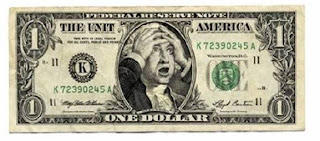 So let me guess.....we are supposed to have confidence that the very ones who got us into this mess are suggesting they are the ones that can fix it.......
Albert Einstein once said “The definition of insanity is doing the same thing over and over again and expecting different results”.
Does this not look a bit like insanity? Why don't we learn from history? Please read the following article from The Wall Street Journal on the history of bailouts......I had no idea of this history.....why isn't this being taught in school?
WALL STREET JOURNAL
SEPTEMBER 20, 2008
Government Bailouts: A U.S. Tradition Dating to Hamilton
The bubble pops. Lenders freeze. Depositors lose faith. Panic spreads. And the government steps in because nobody else will.
Today it is Treasury Secretary Henry Paulson and Federal Reserve Chairman Ben Bernanke putting together the rescue package for a financial system rocked by falling home prices and a wave of defaults on subprime mortgages.
But a short walk through U.S. history demonstrates the point made by Alex J. Pollock of the American Enterprise Institute: "If you would like an empirical law of government behavior, it is that in a panic or threatened financial collapse, governments intervene -- every government, every party, every country, every time."
The Panic of 1792
The nation's first president was in his first term when the U.S. ran into its first financial panic.
In 1791, the federal government assumed obligations that such states as Massachusetts and South Carolina owed from the Revolutionary War, part of a larger deal that included moving the national capital from New York to Philadelphia to Washington. Taking on the states' obligations added about $18 million to a total U.S. domestic debt of $65 million -- debt securities that proved attractive to financial speculators.
Primary among them was William Duer, a well-connected New York businessman who schemed to start a New York bank to drive down the price of Bank of New York stock and win control of BONY on the cheap. He and his colleagues also intended to corner the market on government 6% bonds, so-called Sixes.
Treasury Secretary Alexander Hamilton, the founder of BONY, watched the developments with alarm. "I have learnt with infinite pain the circumstance of a new Bank having started up in your City," Mr. Hamilton wrote to a New York associate, according to research by economic historians Richard Sylla, Robert E. Wright and David J. Cowen. "Its effects cannot but be in every view pernicious," because of the damage they caused to "the whole system of public Credit, by disgusting all sober Citizens and giving a wild air to everything."
The price for Sixes in New York jumped markedly from early December to mid-January. By March, the bubble had burst, with the price of the bonds dropping 25% over two weeks.
Working without a historical blueprint, Hamilton engineered an innovative response. The Treasury borrowed money from the banks and used it to buy government bonds, lifting the market price. He also told banks to accept bonds as collateral for loans to securities brokers, with the government guaranteeing the collateral.
"What Hamilton did in 1792 is just like what Paulson and Bernanke are doing now," said Mr. Sylla, who teaches at the Stern School of Business at New York University.
The financial system stabilized in April, and not a single bank failed until 1809. Mr. Hamilton's improvisation did the trick, or at least so concludes Mr. Wright, also at NYU. He named his son Alexander Hamilton Was Wright.
The Panic of 1907
The century that followed was punctuated by financial instability. There was the panic of 1819, during which states passed laws delaying foreclosures on real estate and personal property.
In 1841, another bout of financial volatility sent land values plummeting. States that had been depending on land taxes suddenly found themselves short of cash; nine of them defaulted on their debts. There was talk of a federal bailout, but Congress balked. Some states raised taxes and paid up; others swapped canals or other assets with their creditors.
"There were banking panics all of the time," said Princeton University economist Alan Blinder, former vice chairman of the Federal Reserve Board. "The banking panic of 1907 was particularly pernicious."
One immediate cause of the panic involved a failed attempt to corner the market on stock in a particular copper company. That led to a run on banks and trusts that had made loans for the plot, starting with the Knickerbocker Trust Co. Public confidence in other financial institutions soon evaporated.
The Treasury injected millions of dollars into the banking system. But it was really J. Pierpont Morgan, the banking magnate and undisputed king of New York financial markets, who saved the day. He had been in Virginia for a church conference when the panic hit, and he took an overnight train back to New York City. He dispatched his lieutenants to figure out which banks were in the worst trouble, then he called the bankers to his home. Working through the night, he browbeat the others into forming a joint pool of capital that they would use to pay depositors at banks that faced runs.
Once depositors saw that they were going to get their money, the panic eased. "Where's J.P. Morgan when we need him?" joked Mr. Blinder.
Six years later, Congress established the Federal Reserve system, creating a lender of last resort for the country's financial system.
The Great Depression
By 1933, four years after the infamous stock-market crash, about 1,000 American homeowners a day were losing their houses to the bank. President Franklin Delano Roosevelt and Congress created the Home Owners' Loan Corp., an ambitious government agency designed to prevent foreclosures on an enormous scale.
The agency bought defaulted mortgages from banks, then refinanced them at lower rates for fixed, 15-year terms. Over the three years it accepted applications, the agency was swamped with 1.9 million requests; about half of the applicants had monthly incomes of between $50 and $150.
Ultimately, the agency issued mortgages, averaging $3,039 apiece, to some one million homeowners. About one in 10 Americans with nonfarm, owner-occupied dwellings secured aid from the agency, according to a 1951 paper by C. Lowell Harriss of Columbia University.
The current mortgage crisis involves securities backed by subprime home loans. But during the 1930s, there was no secondary market for securitized mortgages. So the agency had to hold the mortgages for the full terms. It finally closed up shop in 1951, with about 80% of borrowers having paid their loans off on time or early.
The agency earned the government a small profit. "You save 80% of the people from being tossed out of their homes, and it didn't end up costing the government a dollar," said Lee Davison, a historian at the Federal Deposit Insurance Corp., another Great Depression creation.
Savings and Loan Crisis
It used to be that savings-and-loan associations were staid institutions that stuck to home loans and lured savings-account depositors with blankets and toasters. But during the 1980s, the industry expanded wildly into commercial real-estate lending, spurred by deregulation and poor regulation, according to Mr. Blinder.
The business model worked as long as the S&Ls made more money on their loans than they had to pay for deposits. But the model broke down when interest rates rose, and the institutions found themselves paying more for deposits than they earned from fixed-rate loans in their portfolios.
"In addition," said Mr. Blinder, "they went into a lot of what could only be called stupid real-estate investments."
From 1986 through 1995, about half of the 3,234 S&Ls in the U.S. closed, leaving federal insurers stuck with tens of billions of dollars in bad loans. In 1989, after eight months of debate, Congress created the Resolution Trust Corp. to make depositors whole, investigate allegations of wrongdoing and deal with the husks of the S&L industry.
At the time, skeptics warned that government was reaching too far into the marketplace, and predicted darkly the RTC would be saddled with bad assets for generations.
Indeed, the government ended up owning shopping centers, homes and resorts, along with an odd collection of assets put up as collateral for S&L loans, including Picasso and Warhol paintings, a 30-horse merry-go-round, a Colonial-era whiskey distillery, a drawstring made from Martha Washington's gown and 800 units of semen from a registered Brahma bull.
By the time the S&L cleanup was over, it had cost U.S. taxpayers about $124 billion in non-inflation-adjusted dollars, according to FDIC research. Mr. Davison, the FDIC historian, wrote in a 2006 journal article: "Perhaps a measure of the RTC's success is that little more than a decade after it closed, this agency that provoked so much debate is now largely forgotten."
—Greg Hitt and Louise Radnofsky contributed to this article.
Wednesday, September 24, 2008
The Ugly Side of Immigration (Illegal)
I grew up in Arizona near Tucson and there were Mexicans in the town where I grew up. There were Mexicans working in the copper industry throughout Arizona, New Mexico and other industries along the border. We never had the trouble that is going on now.
What is now happening is not an invasion of Mexico but an invasion of the drug industry people that Mexico is unable to control. What is a tragedy is that American citizens are caught in the middle of this and their rights to "Life, Liberty and the pursuit of Happiness" are being trampled on by a criminal element. The other part of that tragedy is that the very government brought about by the greatest Constitution every written has wandered so far from the intent of that document as to be powerless to stop this travesty of justice.
Remember Ignacio Ramos and Jose Campeon? Here is their story from the news article: "These are Border Patrol agents who, in an incident near Fabens, Texas, in 2005, shot a fleeing drug-smuggler in the butt and wound up going to jail for 11 and 12 years, respectively. The U.S. attorney gave the drug-runner immunity to testify against the agents.
When it comes to the law versus the smugglers, the message that sends is crystal-clear. It's also difficult to reach any other conclusion when you hear a federal judge rule that illegal aliens have a right to interstate travel, as John Roll did in March, in a civil-rights case involving high-profile rancher Roger Barnett, a corridor resident. "
We have a serious crisis along the border and it does not even register on our national news....
If you want to see some of the most rugged of mountain ranges and areas and at the same time some of the most beautiful, use Google Earth and the areas named in this news article to locate them......this is all being ruined because we won't allow our enforcement agencies to do their jobs.

Drug-trafficking and crime victimize residents and destroy the environment along the Southern Arizona-New Mexico border
By LEO W. BANKS

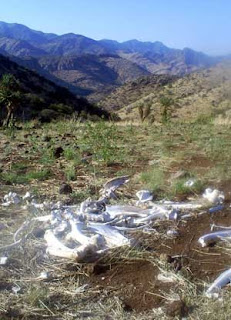


The roar of an ATV is hard to miss at 3 a.m. on a dark night in the Chiricahua Mountains. The sound carries a mighty distance, ricocheting through the canyons--and to anyone living in that place, in these times, it's recognized immediately as the sound of trouble.
So it was the night of July 16, when an ATV, almost certainly loaded with drugs, rumbled north across the Mexican border. It likely crossed the line on the west end of the San Bernardino National Wildlife Refuge, east of Douglas, came north along Black Draw through the heart of the San Bernardino Valley, then swung west across State Highway 80 into the Pedregosa Mountains.
From there, the smuggler bulled his way north through draws and washes up to Rucker Canyon on the west side of the Chiricahuas, possibly as far as Turkey Creek. It was a mad dash for sure, and the best evidence indicates he rode the entire distance, as much as 40 miles, in a single night, his wheels turned backward to foil trackers.
Residents view the ATV incursion, the first of several, as an escalation in an already intense battle with smugglers working the so-called Chiricahua Corridor. Perhaps optimistically, some view this pathway through southeast Arizona as one of the last wide-open border smuggling routes, and they fear the traffickers will grow more desperate as they fight to keep it open.
Already, residents have had to make room in their lives for everything the traffickers bring with them--suspicion, constant watchfulness, vandalism and break-ins. As a matter of course, few people dare leave their homes without a sitter. Alex Stone, a helicopter specialist for the Forest Service who owns a house near Portal, on the east side of the Chiricahuas, says flatly, "If you leave your house empty, it will be occupied."
Law enforcement? Border Patrol might be an hour away on a good day, and on a bad day, residents have to fend for themselves when the agency dispatcher in Douglas says, as sometimes happens, "Sorry, we have nobody to send."
The traffic has also brought to the Chiricahua Mountains, one of Arizona's special places, the same ugliness we see in other sanctuaries closer to the border: Piles of trash now foul major canyons and waters in the northeastern part of the range. Erosion bedevils established hiking trails, and illegals are making new trails in areas as high as 9,000 feet.
What's happening in the corridor challenges the government's campaign of using this year's decrease in arrests, nearing 25 percent in some areas, to convince citizens they're finally getting the border under control. It also shows the relentless northward march of the smugglers. After all, those who cross the Chiricahuas and walk all the way to Interstate 10, at the northern end of the corridor, have trekked nearly 70 punishing miles--evading law enforcement--putting them deep into the United States.
What is now happening is not an invasion of Mexico but an invasion of the drug industry people that Mexico is unable to control. What is a tragedy is that American citizens are caught in the middle of this and their rights to "Life, Liberty and the pursuit of Happiness" are being trampled on by a criminal element. The other part of that tragedy is that the very government brought about by the greatest Constitution every written has wandered so far from the intent of that document as to be powerless to stop this travesty of justice.
Remember Ignacio Ramos and Jose Campeon? Here is their story from the news article: "These are Border Patrol agents who, in an incident near Fabens, Texas, in 2005, shot a fleeing drug-smuggler in the butt and wound up going to jail for 11 and 12 years, respectively. The U.S. attorney gave the drug-runner immunity to testify against the agents.
When it comes to the law versus the smugglers, the message that sends is crystal-clear. It's also difficult to reach any other conclusion when you hear a federal judge rule that illegal aliens have a right to interstate travel, as John Roll did in March, in a civil-rights case involving high-profile rancher Roger Barnett, a corridor resident. "
We have a serious crisis along the border and it does not even register on our national news....
If you want to see some of the most rugged of mountain ranges and areas and at the same time some of the most beautiful, use Google Earth and the areas named in this news article to locate them......this is all being ruined because we won't allow our enforcement agencies to do their jobs.

PUBLISHED ON SEPTEMBER 11, 2008:
The Chiricahua Corridor
Drug-trafficking and crime victimize residents and destroy the environment along the Southern Arizona-New Mexico border
By LEO W. BANKS

Leo W. Banks
These peaks above Portal are called Twin Peaks. The illegal alien trail goes along Horseshoe Saddle and drops to the base of the peaks into South Fork.
These peaks above Portal are called Twin Peaks. The illegal alien trail goes along Horseshoe Saddle and drops to the base of the peaks into South Fork.

Leo W. Banks
The remains of a dead cow at Jackwood Pass, high in the Chiricahuas. Illegal aliens walk over the mountains in the background.
The remains of a dead cow at Jackwood Pass, high in the Chiricahuas. Illegal aliens walk over the mountains in the background.

Leo W. Banks
Medications and supplements used by illegal aliens in the Chiricahua Corridor.
Medications and supplements used by illegal aliens in the Chiricahua Corridor.

Leo W. Banks
An illegal alien camp at Burro Springs in the Chiricahua Mountains.
An illegal alien camp at Burro Springs in the Chiricahua Mountains.

Leo W. Banks
Part of the illegal dumpsite at Burro Springs in the Chiricahuas.
Part of the illegal dumpsite at Burro Springs in the Chiricahuas.
The roar of an ATV is hard to miss at 3 a.m. on a dark night in the Chiricahua Mountains. The sound carries a mighty distance, ricocheting through the canyons--and to anyone living in that place, in these times, it's recognized immediately as the sound of trouble.
So it was the night of July 16, when an ATV, almost certainly loaded with drugs, rumbled north across the Mexican border. It likely crossed the line on the west end of the San Bernardino National Wildlife Refuge, east of Douglas, came north along Black Draw through the heart of the San Bernardino Valley, then swung west across State Highway 80 into the Pedregosa Mountains.
From there, the smuggler bulled his way north through draws and washes up to Rucker Canyon on the west side of the Chiricahuas, possibly as far as Turkey Creek. It was a mad dash for sure, and the best evidence indicates he rode the entire distance, as much as 40 miles, in a single night, his wheels turned backward to foil trackers.
Residents view the ATV incursion, the first of several, as an escalation in an already intense battle with smugglers working the so-called Chiricahua Corridor. Perhaps optimistically, some view this pathway through southeast Arizona as one of the last wide-open border smuggling routes, and they fear the traffickers will grow more desperate as they fight to keep it open.
Already, residents have had to make room in their lives for everything the traffickers bring with them--suspicion, constant watchfulness, vandalism and break-ins. As a matter of course, few people dare leave their homes without a sitter. Alex Stone, a helicopter specialist for the Forest Service who owns a house near Portal, on the east side of the Chiricahuas, says flatly, "If you leave your house empty, it will be occupied."
Law enforcement? Border Patrol might be an hour away on a good day, and on a bad day, residents have to fend for themselves when the agency dispatcher in Douglas says, as sometimes happens, "Sorry, we have nobody to send."
The traffic has also brought to the Chiricahua Mountains, one of Arizona's special places, the same ugliness we see in other sanctuaries closer to the border: Piles of trash now foul major canyons and waters in the northeastern part of the range. Erosion bedevils established hiking trails, and illegals are making new trails in areas as high as 9,000 feet.
What's happening in the corridor challenges the government's campaign of using this year's decrease in arrests, nearing 25 percent in some areas, to convince citizens they're finally getting the border under control. It also shows the relentless northward march of the smugglers. After all, those who cross the Chiricahuas and walk all the way to Interstate 10, at the northern end of the corridor, have trekked nearly 70 punishing miles--evading law enforcement--putting them deep into the United States.
PLEASE read the rest of the story of the Chiricahua Corridor
Tuesday, September 23, 2008
House Attempt to Fool Everyone on Drilling and Other Subjects from The PatriotPost


22 September 2008 Patriot Vol. 08 No. 39
FOR THE RECORD
“[T]he House of Representatives approved a bill to allow offshore oil drilling, but nearly all the Republicans voted against it... It isn’t a drilling bill, it’s an anti-drilling bill. If it becomes law, nearly all the oil and gas in the Outer Continental Shelf would be off-limits forever... This bill permanently bans all drilling within 50 miles of the US coast, which just happens to be where most of the recoverable oil and gas reserves are. It permits drilling between 50 and 100 miles out only if the adjoining states agree - which they won’t, since the bill denies them any share in the royalties the oil companies would have to pay, thereby eliminating any financial incentive for a state to say yes. Virtually all the oil off the California coast and beneath the Eastern Gulf of Mexico would be locked up for good. Don’t be fooled: The only offshore drilling this bill really opens the door to would have to be 100 miles or more out to sea, where the oil companies have no infrastructure... According to the Interior Department, the offshore areas where drilling is restricted contain more than 19 billion barrels—that’s equal to 30 years of current imports from Saudi Arabia. The bill would deny Americans access to as much as nine-tenths of that oil. A good deal? I don’t think so.” —Jeff Jacoby
LIBERTY
“The configuration of the financial hurricane will become clear soon enough. The sad thing is that the free market will likely get a disproportionate share of the blame, finding its wrists more tightly shackled if the bloodthirsty critics of free enterprise gain enough power in Washington. Whenever markets mess up, control freaks blame it on too much freedom, on undue latitude for plungers and gamblers and similar riff-raff, when the blame properly rests with the gambling instinct itself, which is a part of human nature. If it weren’t, and thanks goodness it is, the first man to peek outside the cave and see the possibilities of a home on the hillside would never have tried it. ‘Too much risk!’ he would have muttered (in caveman-ese). Nothing ever gets done without risk. Risk entails the possibility of failure, but also of growth and gain. If you don’t want growth, you shun risk. Fortunately, capitalists and entrepreneurs constantly seek growth. They gamble. They stick out their necks, sometimes fatally.” —William Murchison
GOVERNMENT
“With freedom comes responsibility. Those who would have self-government must, by definition, govern themselves. Self-government only works when people act responsibly and fulfill their obligations. When people abuse these freedoms to enrich themselves at the expense of others, then the public will demand the government to step in. That is how government grows, and how freedom is diminished. The prospect of government intervention should be terrifying to corporate leaders. For too long many of them viewed it as a safety net. ...[A]fter the recent federal bailouts, some corporate officers are likely considering seeking the same bailout. As my grandmother was fond of saying, if you reward bad behavior all you are going to get is more bad behavior. Reckless and irresponsible individuals like those at the companies mentioned above give decent corporate managers a bad name. When financial meltdowns occur, the public’s outrage drives government to take over part of the private sector. When the government does so, it replaces irresponsible executives with unaccountable bureaucrats. That takes us out of the frying pan and into the fire.” —Ken Blackwell
Thursday, August 14, 2008
An Affair to Remember - Chuck Norris
 An Affair to Remember
08/12/2008
Now that John Edwards has admitted to his affair with 42-year-old Rielle Hunter, the big test looms again before the American public: Do we care? Do we think it matters? Do we believe that there should be any code of conduct or moral standard for those in public office, even if it is the highest one in the land?Justifications for political improprieties abound. There are historical ones: "Benjamin Franklin, Thomas Jefferson, John F. Kennedy, Bill Clinton, etc. had moral failures, so what's the big deal?" There are also personal ones: "We shouldn't judge. No one is perfect. Who are we to point fingers?"Don't misunderstand me. I believe in personal redemption. I myself have experienced it, as I wrote about in the chapter "A sin that became a blessing" in my autobiography, "Against All Odds," in which I discuss an adulterous one-night stand in the early '60s that resulted in my wonderful daughter Dina. That is why I hope, as he says, John Edwards truly has asked God and his wife for forgiveness, and I pray for their restoration and the long road that results from it.
But then again, John Edwards continues to minimize his culpability by playing linguistic and moral dodge ball. He lied to his closest colleagues and the public for nearly two years about the affair. And even in his confession last week, he doesn't call it a "lie," a "sin," an "affair" or "adultery." Rather, he repeatedly calls it merely a "mistake" or a "serious error in judgment." Is that all it is?
To read the rest of the column CLICK HERE
Tuesday, August 05, 2008
The Patriot Post - Our Vision

About The Patriot Post
America's most widely read Internet-based publication, The Patriot Post, is a highly acclaimed journal advocating individual liberty, the restoration of constitutional limits on government and the judiciary, and the promotion of free enterprise, national defense and traditional American values.
The Patriot Post is crafted by a national editorial team headed by Mark Alexander and serves as a hard-hitting rebuttal to contemporary political, social and mainstream media protagonists on the Left. It is written for those who seek a brief, informative and entertaining analysis of the week's most significant news, policy and opinion. This comprehensive synopsis of reliable information is drawn from reputable media, research and advocacy organizations and published in three parts each week: Monday's Patriot Brief, Wednesday's Patriot Chronicle and Friday's Patriot Digest.
The Patriot Post's readers include high-level policymakers in the executive and legislative branches, leaders in state and local government, key thinkers in the community of conservative research and academic policy organizations, and, most important, grassroots conservatives across the nation. The Patriot Post is available free by e-mail, and is thus an invaluable news resource for hundreds of thousands of our military and mission-field personnel around the world, as well as an ever-growing readership on our college campuses.
Our Vision

"For we must consider that we shall be as a City upon a hill. The eyes of all people are upon us. So that if we shall deal falsely with our God in this work we have undertaken, and so cause Him to withdraw His present help from us, we shall be made a story and a byword throughout the world. ... Beloved there is now set before us life and good, Death and evil, in that we are commanded this day to love the Lord our God, and to love one another, to walk in his ways and to keep His Commandments and His Ordinance and His laws, and the articles of our Covenant with Him, that we may live and be multiplied, and that the Lord our God may bless us in the land whither we go to possess it. But if our hearts shall turn away, so that we will not obey, but shall be seduced, and worship and serve other Gods, our pleasure and profits, and serve them; it is propounded unto us this day, we shall surely perish out of the good land whither we pass over this vast sea to possess it; Therefore let us choose life that we, and our seed, may live, by obeying His voice and cleaving to Him, for He is our life and our prosperity." --John Winthrop, 1630 (Pilgrim & First Governor of Massachusetts)
The Patriot Post is the Internet's Journal of Record for the conservative revolution. This, of course, is an ongoing revolution -- one inspired by Ronald Reagan and waged by the American people against the prospect of a tyrannical government that threatens the very liberty that gave it rise. The Patriot Post is an instrument for the dissemination of current and historical conservative thought for the plurality of Americans who uphold the most basic tenet of our Republic: "that all men are created equal, that they are endowed by their Creator with certain unalienable Rights, that among these are Life, Liberty and the pursuit of Happiness."
The Patriot Post believes that individual liberty, the restoration of constitutional limits on government and the judiciary, and the promotion of free enterprise, national defense and traditional American values can only be secured through the exercise of individual rights and responsibilities as ordained by God and established by our nation's Founders in our Declaration of Independence and its subordinate exposition, our Republic's Constitution.
James Madison, in a letter to Thomas Jefferson, 8 February 1825, wrote of the supremacy of the Declaration of Independence over our nation's Constitution: "On the distinctive principles of the Government...of the U. States, the best guides are to be found in...The Declaration of Independence, as the fundamental Act of Union of these States."
The Patriot Post relies, first and foremost, on the writings of our Founders as finite guidance for understanding the plain language of our Constitution, including its most comprehensive explication, The Federalist Papers, a defense of our Constitution by its author, James Madison, and Founders Alexander Hamilton and John Jay.
Like our Founders, we believe that the role for our central government, as defined by the Constitution and outlined in The Federalist Papers in 1787, was, and remains the correct role. To this end, we also believe that the constitutional federalism envisioned by our Founders and outlined by our Constitution's Bill of Rights was grossly violated by our 16th president, Abraham Lincoln. And what was left of federalism in the 20th century was largely dismantled by the administrations of Franklin Roosevelt and Lyndon Johnson, in combination with extra-constitutional judicial diktats, the result of judicial activism beginning in the 1950s and continuing, largely unabated, to the present day.
Indeed, many of the Constitution's faults, as outlined in The Anti-Federalist Papers, have been borne out. Though the Federalists provided a mechanism to alter our Constitution for redress of those issues, few leaders today have the vision and courage of our Founders. As a result, the "central government" prescribed by our Constitution as ratified in 1787 (and affirmed by Ronald Reagan's Executive Order on Federalism) bears little resemblance to the "federal government" today.
For this reason, we believe that dissemination of The Patriot's timeless message of liberty, limited government and free enterprise is critical to the furtherance of our Founders' vision. We are thus eternally indebted to Ronald Reagan, and we are grateful to all those Patriots who, in recent years, have renewed their commitment to our founding principles. As Thomas Paine once said, "Those who expect to reap the blessings of freedom, must, like men, undergo the fatigues of supporting it."
Get Your Own FREE Subscription.
Edit this page (you have permission) Edit this page (if you have permission) | Report spam Google Docs -- Web word processing, presentations and spreadsheets.
Monday, August 04, 2008
What's Wrong With America?
Apathy, a Congress that won't work on behalf of their constituents, a constituancy that will not fight back.
Dems leave on vacation, GOP revolts
Jim Brown - OneNewsNow - 8/2/2008 5:00:00 AM
A group of House Republicans staged a revolt after Democrats passed a non-debatable adjournment resolution to shut down the chamber for a five-week vacation.
Even though lights, microphones and C-SPAN cameras were turned off, about 40 Republicans took to the House floor and railed against Speaker Nancy Pelosi's (D-California) refusal to hold a vote on legislation to allow offshore oil drilling. Their speeches were met with applause from tourists in the visitor's gallery.
One of the GOP protesters, Representative Thad McCotter (R-Michigan), says Republicans were "silenced in a Stalinist manner." "It's a representative government. Our constituents are outraged at the way the Democrats have run this Congress into the ground and done nothing on their behalf, and we were not going to have our people's voices silenced, and we're not going to let this issue go because it's not about Republican or Democrat, it's about American[s]," he argues. "Working Americans cannot afford to wait for gas price relief just because the Speaker wants them to."
He believes part of the reason Congress is so hated by the American people is because they "care more about politics than about working people." "That is why they went on a five-week paid vacation without doing their job," McCotter contends.
McCotter says he understands that Nancy Pelosi's commitment to environmental extremism would lead her to block a vote on increasing domestic energy production, but he does not understand why she would stop members from even talking about the issue on the House floor.
Dems leave on vacation, GOP revolts
Jim Brown - OneNewsNow - 8/2/2008 5:00:00 AM
A group of House Republicans staged a revolt after Democrats passed a non-debatable adjournment resolution to shut down the chamber for a five-week vacation.
Even though lights, microphones and C-SPAN cameras were turned off, about 40 Republicans took to the House floor and railed against Speaker Nancy Pelosi's (D-California) refusal to hold a vote on legislation to allow offshore oil drilling. Their speeches were met with applause from tourists in the visitor's gallery.
One of the GOP protesters, Representative Thad McCotter (R-Michigan), says Republicans were "silenced in a Stalinist manner." "It's a representative government. Our constituents are outraged at the way the Democrats have run this Congress into the ground and done nothing on their behalf, and we were not going to have our people's voices silenced, and we're not going to let this issue go because it's not about Republican or Democrat, it's about American[s]," he argues. "Working Americans cannot afford to wait for gas price relief just because the Speaker wants them to."
He believes part of the reason Congress is so hated by the American people is because they "care more about politics than about working people." "That is why they went on a five-week paid vacation without doing their job," McCotter contends.
McCotter says he understands that Nancy Pelosi's commitment to environmental extremism would lead her to block a vote on increasing domestic energy production, but he does not understand why she would stop members from even talking about the issue on the House floor.
Wednesday, July 30, 2008
Dirty Politics
Here is an example of the dirty infighting that goes on in Congress. Senator Coburn (R-OK) has been blocking an attempt by Senator Reid to pass an $11 billion spending bill and Senator Reid initiated a Senate Ethics committee hearing on Senator Coburn for delivering babies for free.
This is from the Family Research Council:
What Does Sen. Reid Have Against Babies?
Of the nearly 890 Senate bills passed this session, you may be surprised to learn that there has been debate on only 50 of them. The others were approved by "unanimous consent" with little or no discussion. Sen. Tom Coburn (R-Okla.) is one of the many conservatives frustrated by the leadership's disregard for transparency. Repeatedly, Senate Majority Leader Harry Reid (D-Nev.) has decided to ramrod legislation through the chamber without allowing any discourse between leaders. He attempted this--unsuccessfully--with a massive $11 billion spending bill last week. Mockingly called the "Coburn Omnibus" because it contained several programs and expenditures that the Oklahoma Senator opposed, Reid's bundle of fiscally irresponsible projects failed.
Unable to exact revenge on Coburn in the omnibus, liberals are now attacking the senator for his charitable work. The Ethics panel has launched an investigation on Coburn, who, as an obstetrician, delivers babies for free. As a member of Congress, Coburn can't receive payment for his work at Muskogee Regional Medical Center because of a "potential conflict of interest." Since Muskogee is now a private facility, the Ethics panel says it has new concerns. Coburn's office came out swinging. "...[P]arents don't choose to receive his services at a particular hospital because Dr. Coburn has somehow endorsed [it]... Has Sen. Leahy provided an improper endorsement to Warner Brothers for appearing in Batman?"
Is Sen. Reid foolish enough to publicly oppose volunteerism? He and his liberal attack dogs seem bent on tearing down the generous work of a citizen legislator. No doubt this would have been a non-issue if instead of delivering babies, Sen. Coburn had offered to abort them.
For the full story from The Hill, an online newspaper, please click
HERE
This is from the Family Research Council:
What Does Sen. Reid Have Against Babies?
Of the nearly 890 Senate bills passed this session, you may be surprised to learn that there has been debate on only 50 of them. The others were approved by "unanimous consent" with little or no discussion. Sen. Tom Coburn (R-Okla.) is one of the many conservatives frustrated by the leadership's disregard for transparency. Repeatedly, Senate Majority Leader Harry Reid (D-Nev.) has decided to ramrod legislation through the chamber without allowing any discourse between leaders. He attempted this--unsuccessfully--with a massive $11 billion spending bill last week. Mockingly called the "Coburn Omnibus" because it contained several programs and expenditures that the Oklahoma Senator opposed, Reid's bundle of fiscally irresponsible projects failed.
Unable to exact revenge on Coburn in the omnibus, liberals are now attacking the senator for his charitable work. The Ethics panel has launched an investigation on Coburn, who, as an obstetrician, delivers babies for free. As a member of Congress, Coburn can't receive payment for his work at Muskogee Regional Medical Center because of a "potential conflict of interest." Since Muskogee is now a private facility, the Ethics panel says it has new concerns. Coburn's office came out swinging. "...[P]arents don't choose to receive his services at a particular hospital because Dr. Coburn has somehow endorsed [it]... Has Sen. Leahy provided an improper endorsement to Warner Brothers for appearing in Batman?"
Is Sen. Reid foolish enough to publicly oppose volunteerism? He and his liberal attack dogs seem bent on tearing down the generous work of a citizen legislator. No doubt this would have been a non-issue if instead of delivering babies, Sen. Coburn had offered to abort them.
For the full story from The Hill, an online newspaper, please click
HERE
Friday, July 25, 2008
Bush Should Strip Sanctuary Cities of Federal Funds
Thursday, July 24, 2008
Bush Should Strip Sanctuary Cities of Federal Funds
by Michael Reagan
Three good men are dead thanks largely to San Francisco’s outrageous sanctuary-city policy, which forbids city authorities from notifying federal immigration authorities when they arrest illegal aliens for crimes they commit, and it’s time for President Bush to crack down on all the cities in the United States that follow this absurd policy.
On June 22, Anthony Bologna and his sons Michael and Matthew were shot to death by Edwin Ramos, 21, after a brief traffic incident when Anthony Bologna allegedly briefly blocked Ramos' car from making a left turn, according to the San Francisco Chronicle.
Ramos, an alleged member of the vicious the Mara Salvatrucha gang, known as MS-13, should never have been around to kill the three men, and wouldn’t have been -- were not for the city’s sanctuary-city policy. Ramos, an illegal immigrant, was found guilty of committing two felonies when he was 17 -- involving a gang-related assault of a Municipal Railway passenger and the attempted robbery of a pregnant woman -- yet was never surrendered by the city’s juvenile justice authorities to federal officials for possible deportation as required by federal law.
Ramos was taken to juvenile hall on charges of assault and participating in a street gang, and was later convicted in juvenile court and put in a shelter. Under federal law, he should have been referred to the Immigration and Customs Enforcement agency (ICE) but the Juvenile Probation Department's policy for dealing with offenders stipulated that "probation officers shall not discriminate in any fashion against minors based on their immigration status."
On April 2, 2004, Ramos was released to the custody of his mother, despite the fact that he had already been flagged by federal authorities as an illegal immigrant. He was still considered a ward of the court and was on probation. Just four days later, records show, he committed another crime at 19th and Mission streets, two blocks from the site of the attack on the Muni passenger. He was released after city prosecutors declined to charge him in connection with an arrest in March on suspicion of weapons and gang violations.
There is a dispute revolving around the question of whether ICE was ever notified of the Ramos arrest, but the fact remains that for the last 10 years the city’s juvenile justice authorities have followed a policy of not turning over illegal-immigrant felons to the federal government, basing the practice on San Francisco's sanctuary-city status and state law barring local officials from surrendering them for deportation.
After a storm of protest following the slayings of the Bologna family men, San Francisco’s ultra-liberal Mayor Gavin Newsom belatedly rescinded that policy earlier this month following a report in the Chronicle that the city had flown a number of youths out of the country on its own, in possible violation of federal law, and then housed some in unlocked group homes from which they quickly escaped. His action came too late to save the lives of the Bologna men.
Those are the facts in this shocking case. They illustrate the lethal effects this idiotic and dangerous sanctuary-city policy can have on the safety of innocent Americans.
Sanctuary-city policies defy guidelines from the 9/11 Commission Report, which called on state and local authorities to help federal agencies crack down on illegal immigration. “There is a growing role for state and local law enforcement agencies [for the enforcement of immigration law],” the report stated. “They need more training and work with federal agencies so that they can cooperate more effectively with those federal authorities in identifying terrorist suspects.”
Instead, a host of cities across the United States classify themselves as havens for illegal aliens, despite the fact that such policies result in creating safe havens for illegal aliens who are criminals and potential terrorists. They allow criminal aliens to avoid deportation because they prevent local police from reporting them to ICE.
President Bush should issue an executive order denying any federal funds to those cities which either officially or unofficially provide sanctuaries enabling illegal aliens who commit crimes to escape deportation. They need to learn there is a price to be paid for exposing their citizens to criminal activities by aliens here illegally.
Bush Should Strip Sanctuary Cities of Federal Funds
by Michael Reagan
Three good men are dead thanks largely to San Francisco’s outrageous sanctuary-city policy, which forbids city authorities from notifying federal immigration authorities when they arrest illegal aliens for crimes they commit, and it’s time for President Bush to crack down on all the cities in the United States that follow this absurd policy.
On June 22, Anthony Bologna and his sons Michael and Matthew were shot to death by Edwin Ramos, 21, after a brief traffic incident when Anthony Bologna allegedly briefly blocked Ramos' car from making a left turn, according to the San Francisco Chronicle.
Ramos, an alleged member of the vicious the Mara Salvatrucha gang, known as MS-13, should never have been around to kill the three men, and wouldn’t have been -- were not for the city’s sanctuary-city policy. Ramos, an illegal immigrant, was found guilty of committing two felonies when he was 17 -- involving a gang-related assault of a Municipal Railway passenger and the attempted robbery of a pregnant woman -- yet was never surrendered by the city’s juvenile justice authorities to federal officials for possible deportation as required by federal law.
Ramos was taken to juvenile hall on charges of assault and participating in a street gang, and was later convicted in juvenile court and put in a shelter. Under federal law, he should have been referred to the Immigration and Customs Enforcement agency (ICE) but the Juvenile Probation Department's policy for dealing with offenders stipulated that "probation officers shall not discriminate in any fashion against minors based on their immigration status."
On April 2, 2004, Ramos was released to the custody of his mother, despite the fact that he had already been flagged by federal authorities as an illegal immigrant. He was still considered a ward of the court and was on probation. Just four days later, records show, he committed another crime at 19th and Mission streets, two blocks from the site of the attack on the Muni passenger. He was released after city prosecutors declined to charge him in connection with an arrest in March on suspicion of weapons and gang violations.
There is a dispute revolving around the question of whether ICE was ever notified of the Ramos arrest, but the fact remains that for the last 10 years the city’s juvenile justice authorities have followed a policy of not turning over illegal-immigrant felons to the federal government, basing the practice on San Francisco's sanctuary-city status and state law barring local officials from surrendering them for deportation.
After a storm of protest following the slayings of the Bologna family men, San Francisco’s ultra-liberal Mayor Gavin Newsom belatedly rescinded that policy earlier this month following a report in the Chronicle that the city had flown a number of youths out of the country on its own, in possible violation of federal law, and then housed some in unlocked group homes from which they quickly escaped. His action came too late to save the lives of the Bologna men.
Those are the facts in this shocking case. They illustrate the lethal effects this idiotic and dangerous sanctuary-city policy can have on the safety of innocent Americans.
Sanctuary-city policies defy guidelines from the 9/11 Commission Report, which called on state and local authorities to help federal agencies crack down on illegal immigration. “There is a growing role for state and local law enforcement agencies [for the enforcement of immigration law],” the report stated. “They need more training and work with federal agencies so that they can cooperate more effectively with those federal authorities in identifying terrorist suspects.”
Instead, a host of cities across the United States classify themselves as havens for illegal aliens, despite the fact that such policies result in creating safe havens for illegal aliens who are criminals and potential terrorists. They allow criminal aliens to avoid deportation because they prevent local police from reporting them to ICE.
President Bush should issue an executive order denying any federal funds to those cities which either officially or unofficially provide sanctuaries enabling illegal aliens who commit crimes to escape deportation. They need to learn there is a price to be paid for exposing their citizens to criminal activities by aliens here illegally.
Subscribe to:
Posts (Atom)